
Zindagi Na Milegi Dobaara: An NLP Lens on a Film That Mirrors Us Back
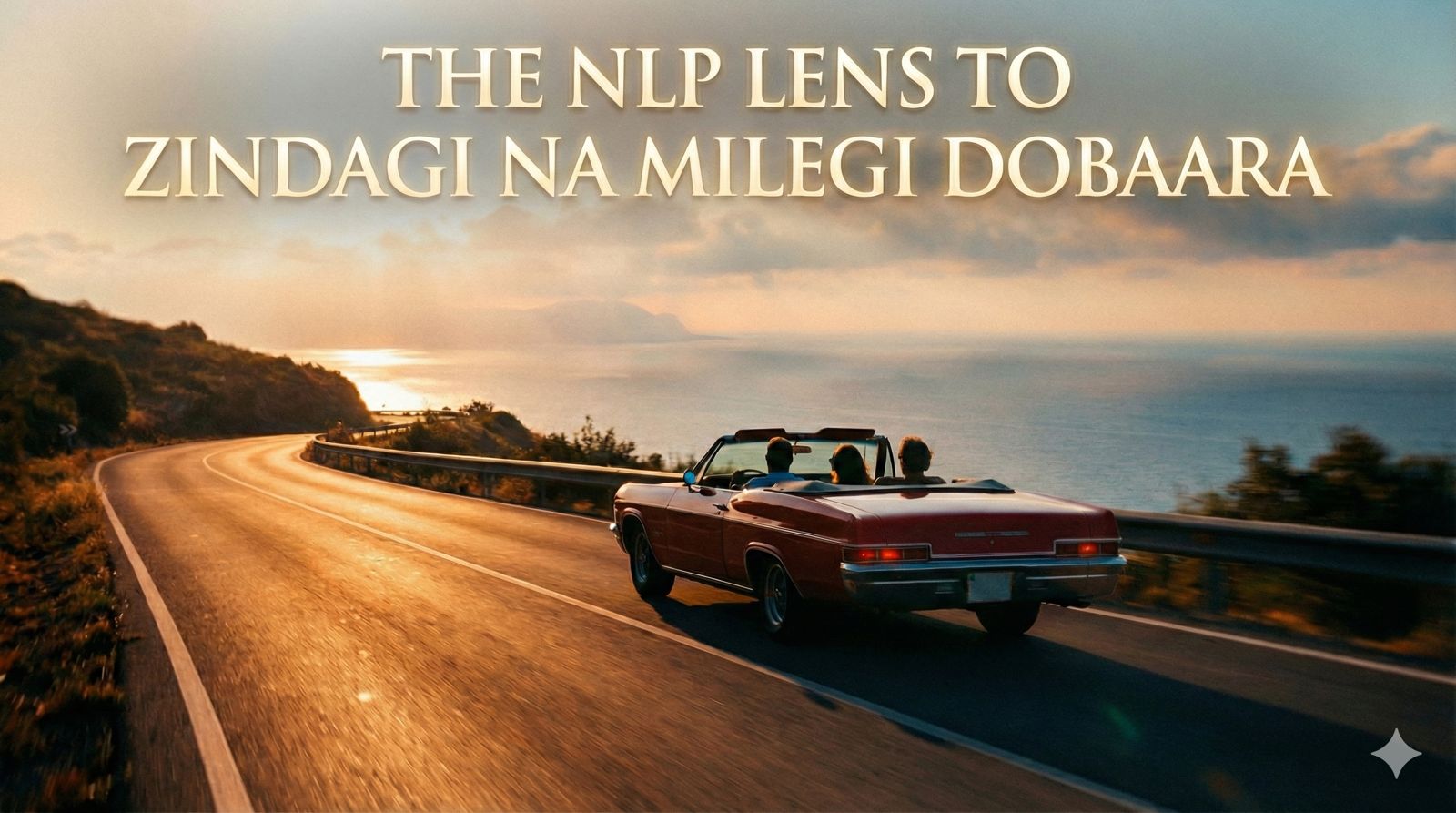
Today is 2–12.
Do-baara.
A date that whispers a simple reminder: life always gives you another chance, if you’re willing to take it.
And there couldn’t be a better day to revisit the film that turned “seize the moment” into a lived philosophy: Zindagi Na Milegi Dobaara.
But today, let’s watch it through a different lens:
Your NLP lens, the inner movie that runs beneath the outer movie.
The Film We All Watched v/s The Inner Film We All Lived.
ZNMD wasn’t just a road trip.
It was an inner trip, like an NLP workshop disguised as a Bollywood blockbuster.
Three friends set out on holiday, but each one is actually escaping:
- Arjun is escaping his past.
- Imran is escaping his truth.
- Kabir is escaping his future.
Look closely and you’ll notice:
Every character is stuck not in circumstances, but in internal representations – the images, sounds, meanings and emotional anchors they have unconsciously built over years.
Just like us.
1. Arjun: The Prison of Old Anchors
Arjun’s life runs on one dominant anchor:
“Work gives me safety.”
But safety for him isn’t a feeling — it’s a compulsion.
His internal representation of life is a tight frame:
Work → Money → Control → Certainty.
When Laila asks him, “Tum kaam kab karte ho aur jeete kab ho?”,
she is doing a classic Meta Model challenge by questioning his rigid linguistic distortions.
She breaks his pattern so he can breathe again.
His transformation is essentially a state change:
From tight, rushed, urgent to open, relaxed, trusting.
Breathwork in the skydiving scene is literal, but it’s also metaphoric:
Sometimes the only way out of fear is through the body, not the mind.
2. Imran: The Rewrite of Meaning
Imran hides pain behind humour, which is a perfect example of dissociation.
He speaks in sarcasm so he never has to speak his truth.
When he meets his father, that one conversation reframes his identity.
Not externally, but internally.
This is reframing at its finest:
Same father.
Same absence.
New meaning.
What was once “He didn’t want me” becomes
“He couldn’t give me what I expected.”
And that’s not the same thing.
A shift in meaning creates a shift in the entire story.
That is exactly what NLP does.
3. Kabir: The Conflict of Parts
Kabir is the perfect case study for Parts Integration.
One part of him genuinely loves Natasha.
Another part of him wants freedom.
One part is fulfilling a promise.
Another part is terrified of losing himself.
He doesn’t need advice.
He needs alignment.
And it happens when he finally listens to the part that has been whispering the truth all along.
ZNMD shows beautifully that clarity rarely comes from others.
It comes when your inner parts stop fighting and start collaborating.
4. The Spain Trip: A Spatial Anchor for Transformation
Every city becomes an anchor:
- Costa Brava stands for Fun.
This is where the boys finally loosen up, take their first big leap into deep-sea diving and meet Laila, who gently nudges them out of their seriousness. It is the place where their guardedness dissolves and the trip truly begins.
- Seville stands for Expression.
Here they step into the world of Flamenco, poetry, honest conversations and emotional unmasking. Arjun softens, Imran confronts his truth and Kabir begins to face his dilemma, all in a city that celebrates openness and passion.
- Pamplona stands for Courage.
The Running of the Bulls forces each of them to stop running from themselves. It becomes the moment where fear meets action, where clarity becomes commitment and where their inner shifts turn into bold choices.
Environment shifts state.
State shifts choices.
Choices shift life.
The landscape changes them because a change in space leads to a change in inner stories.
This is why travelling often feels therapeutic.
It’s NLP’s spatial anchoring working quietly in the background.
So What Is the NLP Lesson of ZNMD?
Simple:
Life changes the moment your inner movie changes.
Arjun changed his pace.
Imran changed his meaning.
Kabir changed his choices.
The outer world moved only after the inner world shifted.
And that’s the magic of NLP.
It hands you the remote control of your mind, so that you can direct the film you truly want to live.
A Gentle Reminder Today (2-12, Dobaara)
You do not get another life.
But you do get another chance.
A chance to reinterpret, to realign, to re-anchor, to re-choose.
Every fear can be re-scripted.
Every belief can be re-framed.
Every identity can be re-written.
Every past can be re-perceived.
And every moment offers you a “Dobaara” – if you’re willing to press “Play” again.
Next steps
Continue Your W3 Journey
The conversation doesn’t have to end here. Explore, reflect and continue your journey across Wealth, Wisdom and Wellness.
01
What’s Your W3 Quotient?
How balanced is your success across Wealth, Wisdom and Wellness?
Take a few minutes to discover your W3 Quotient. You may find that the results reveal something worth thinking about.
02
Never Miss a New Thought
Subscribe to W3 Coach and receive updates whenever new content is published, from NLP Around You and the W3 Blog to Lights! Camera! NLP!, Thoughtful Thoughts and whatever comes next.